By: dr. Armand Achmadsyah
Calcium deposits in the heart’s arteries are one of the most challenging problems in interventional cardiology. At RS Abdi Waluyo Cardiac Center, we offer Intravascular Lithotripsy (IVL) — an advanced, minimally invasive procedure that breaks apart hardened calcium blockages from inside the artery, allowing the heart to receive better blood flow and ensuring stents are placed with optimal results.
What is IVL?
Intravascular Lithotripsy (IVL) is a minimally invasive cardiac procedure that uses a special metal pressure principle to break apart calcium deposits inside the coronary arteries — without damaging the surrounding vessel wall.
This method improves blood flow to the heart muscle and enables more optimal stent placement — especially in blood vessels that are severely calcified and resistant to conventional treatment.
“IVL is not a replacement for a stent. It is a preparation step used before stent placement. Once calcium is broken and the vessel becomes more flexible, the doctor proceeds with optimal stent deployment.”
Benefits of IVL
- Optimal stent expansion: Stent expands more fully and adheres better to the vessel wall after calcium is treated.
- Restored blood flow: Blood flow to the heart muscle is restored more fully and effectively.
- Minimal vessel trauma: Works precisely on calcium only, causing minimal trauma to surrounding healthy vessel tissue.
- Handles complex cases: Treats cases previously considered difficult or impossible with conventional balloons or stents.
- Targets calcium directly: Delivers focused pressure precisely to calcium layers — both superficial and deep within the vessel wall.
- Better long-term outcomes: Reduces the risk of stent re-narrowing and improves long-term success in severe calcification cases.
Who needs IVL?
IVL is recommended for patients with the following conditions:
- Moderate to severe coronary calcification: Calcium deposits in the coronary arteries that prevent optimal stent expansion — the primary indication for all IVL technology.
- Balloon-resistant lesions: Calcified areas that cannot be opened with standard angioplasty balloons or non-compliant balloons.
- Risk of stent underexpansion: Conditions where calcium prevents the stent from opening to the expected size, increasing the risk of re-narrowing.
The IVL procedure
- Vascular access: A catheter is inserted through the wrist or groin. No open surgery required.
- Identifying the calcification: The location of narrowing and calcification is mapped using coronary angiography for precise targeting.
- IVL balloon placement: The IVL balloon is positioned precisely at the heavily calcified segment of the artery.
- Calcium is broken apart: IVL uses a special metal pressure principle to break calcium from inside the artery — without damaging the coronary vessel wall.
- Stent placement: Once the vessel is more flexible, the balloon is expanded and a stent is placed optimally — ensuring the best possible result.
IVL + IVUS combination
IVL is frequently combined with Intravascular Ultrasound (IVUS) imaging to ensure the cardiac stent is placed perfectly and accurately. IVUS provides real-time imaging from inside the artery, giving the cardiologist a precise view of calcium location, vessel dimensions, and stent expansion quality.
LithiX IVL — special advantage
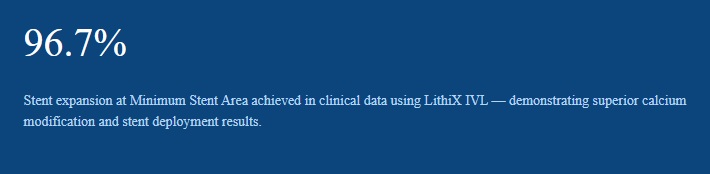 Broader calcium morphology coverage
Unlike other IVL systems, LithiX is designed to treat a wider range of calcium morphologies — including eccentric, concentric, and nodular calcium — and can reach tortuous, difficult-to-access coronary anatomy.
No external generator required
LithiX does not require an external energy generator, making the procedure workflow simpler, faster, and more efficient for both doctor and patient.